
MELBOURNE DELIVERY [PALLET FREIGHT TO YOUR DRIVEWAY]
Hybrid flooring Melbourne — four seasons, one core.
THE MECHANISM [01]
A 40° northerly, then a cold front by dinner. The core doesn't notice.
Melbourne's weather is hard on timber.
Four seasons in a day is a joke until it is your floor: hot northerlies, a southerly change, then ducted heating running half the year. Solid timber expands and contracts with every swing — gaps open near heating vents every winter, and cupping follows damp changes. Laminate fares better but still dislikes the wet entryway months.
Every board we stock is built on a rigid SPC stone-composite core. Stone holds its dimensions through heat, cold snaps and heating cycles alike, and the core is 100% water resistant — winter boots and umbrella drips sit on the board, not in it. The boards float over concrete slabs and most existing tiles, and our SPC range is 0% crystalline silica, so cutting boards does not fill your home with hazardous dust. Running heating? See our underfloor heating compatibility guide. Prefer real timber? Our engineered timber range rides the same pallet network south — hybrid vs engineered timber settles which suits your rooms.
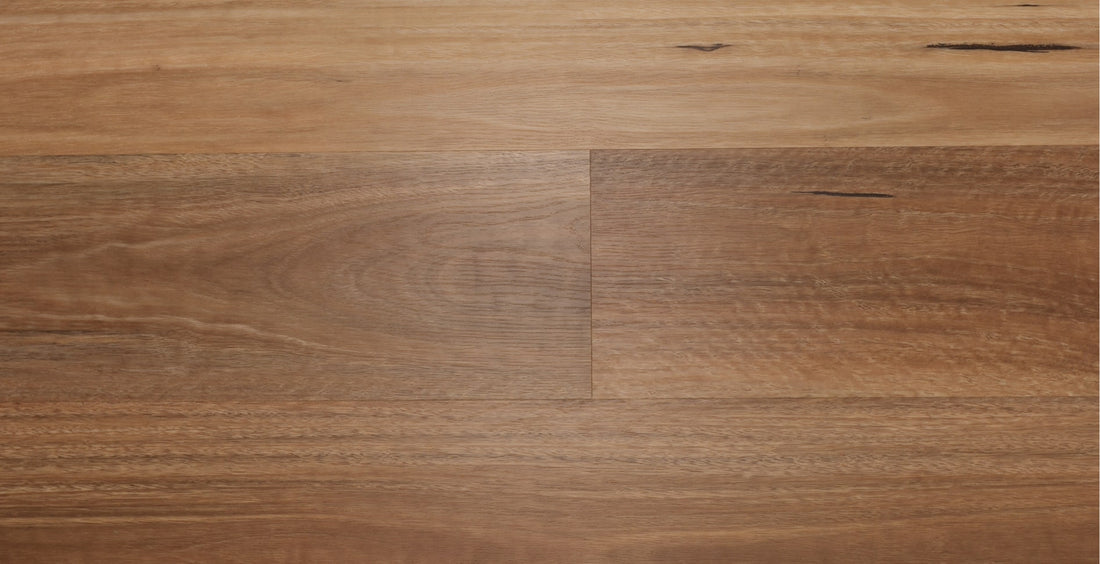
MELBOURNE PICKS [PER BOX INC GST]
Boards Melbourne homes order most
Herringbone leads Melbourne orders — it belongs in the city's terraces and period renovations — with cooler oak tones close behind. Every product page publishes the full spec: wear layer, core, acoustic rating, per-m² price.
 French Oak SPC Hybrid Floorboards Herringbone 7.5+2mmHerringbone — the period-home classicFROM [$82.94/BOX]
 Natural Blackbutt SPC Hybrid Floorboards 7.5+2mmPremium 9.5mm — warm against grey skiesFROM [$83.47/BOX]
 Coastal Blackbutt SPC Hybrid Floorboards 5+1.5mmAustralia's favourite blonde, entry priceFROM [$78.00/BOX]
 Pale Sand SPC Hybrid Floorboards 5+1.5mmLight boards for dark wintersFROM [$78.00/BOX]
CHOOSING A COLOUR [IN MELBOURNE LIGHT]
Choosing a colour in Melbourne light
Colour is the decision you live with longest — and Melbourne's soft, grey-leaning light cools every timber tone a notch. A board that reads balanced under Brisbane sun can pull flat in a south-facing terrace in July. Pick a tone family, then prove it with real samples at home.
Still tossing up? Order free samples and check them morning, noon and under lamps at night — Melbourne light shifts timber tones more than any showroom display will admit. Our colour guide walks the whole decision.
THE HONEST COMPARISON [02]
Hybrid against the rest, in Melbourne conditions
Every floor type earns its place somewhere. This is how they stack up for the way Melbourne actually lives — the same comparison we talk customers through on the phone.
| Living with it | Hybrid SPC | Engineered timber | Laminate | Vinyl |
|---|---|---|---|---|
| Four-seasons-in-a-day swings | Excellent — stone core stays put | Good — engineered for stability | Good — some movement | Good |
| Heating season (ducted & hydronic) | Stable next to vents; UFH-compatible | Naturally warm underfoot | Moderate — can gap when dry | Moderate |
| Family traffic & pets | High — wear layers up to 0.5mm | Moderate — but can be re-sanded | High surface hardness | Moderate |
| Wet areas & kitchens | Yes — 100% water resistant core | Surface spills only | No — keep to dry rooms | Yes — water resistant |
| Our price guide (per m² inc GST) | ~$35–58 | ~$105–133 | ~$30–80 | ~$25–55 |
Price guide reflects our current ranges per square metre including GST, supply only. Every product page shows its exact price, wear layer and warranty.
DELIVERY [DISPATCH 1–2 BUSINESS DAYS]
Pallet delivery across Greater Melbourne
Orders dispatch within 1–2 business days and arrive on a pallet to your driveway or garage — most metro deliveries land within the week. Freight is calculated automatically at checkout.
Freight is the first question Melbourne buyers ask, so here's the honest shape of it: a pallet interstate isn't free, but the saving against showroom retail covers it several times over on a whole-home order — and checkout shows your exact figure before you pay a cent. Size your job first with the flooring calculator — it includes the 10% cutting allowance — and see delivery information for how shipping works.
DIY OR PRO [MELBOURNE]
Click-lock boards, laid over a weekend
Most Melbourne customers lay our boards themselves — the click system is genuinely DIY, and matching trims finish the job properly. Prefer a pro? Any qualified floor installer can work with our boards; the going metro rate runs roughly $25–40 per square metre depending on floor prep. Winter install tip: bring boxes inside 24–48 hours first so boards acclimatise to room temperature before they lock together.
HYBRID FLOORING MELBOURNE [FAQS]
Questions Melbourne buyers ask us
Is hybrid flooring right for Melbourne's climate?
It is the floor we recommend first for Melbourne, and the reason is movement — or the lack of it. Four seasons in a day means real swings: a 40° northerly, a southerly change the same evening, then ducted heating running from May to September. Solid timber expands and contracts with every one of those swings, which is why gaps near heating vents are a Melbourne winter classic. The SPC core in our boards is limestone and PVC — it holds its dimensions through heat, cold and heating cycles alike, so the floor you lay in summer is the same floor you walk on in July. That stability is the whole point of hybrid.
Do you have a Melbourne showroom?
No — and that is deliberate. Showrooms add rent to every square metre of flooring sold through them. We skipped the showroom, kept a Brisbane warehouse, and publish factory-direct prices on every product page instead. The showroom replacement is simple: free samples (you just cover shipping) checked in your own rooms, in your own light — which is a more honest test than any showroom display, where lighting is chosen to flatter the boards. Between samples, published specs and a phone line answered by people who work with these floors daily, Melbourne buyers get everything a showroom offers except the markup.
Does hybrid flooring work with underfloor and ducted heating?
Yes — hybrid is one of the best floating floors for heated homes, which matters in Melbourne more than anywhere. The stone core conducts and tolerates heat evenly, and because it does not expand and contract the way timber does, you avoid the gapping that heating season causes in solid boards. For hydronic and in-slab systems the usual conditions apply: surface temperature capped around 27°C, gradual warm-up, and an expansion gap at the walls. Our underfloor heating compatibility guide covers the details system by system.
Is hybrid flooring waterproof?
You will see "100% waterproof" shouted everywhere — we choose our words more carefully. Our hybrid flooring is 100% water resistant: the stone-composite core does not absorb water, so winter boots, umbrella drips, spills and mopping do nothing to it. What no floating floor can promise is protection from water rising from underneath — a slab leak needs fixing at the source, whatever floor you own. That is the honest version, and it is why hybrid is the default choice for kitchens, laundries and open-plan living.
How much does hybrid flooring cost in Melbourne?
The same as it costs everywhere on our site — that is the point of publishing prices. Entry 6.5mm hybrid runs around $35–43 per square metre including GST; premium 9.5mm and herringbone sit roughly $52–58. Those are supply prices, shown per square metre and per box on every product page — no quote forms, no showroom markup. As a sanity check, a typical 20m² living room in the entry range lands around $700–860 in boards plus freight. Professional installation typically adds roughly $25–40 per square metre at metro rates depending on floor prep, and the flooring calculator turns your room sizes into a box count in about two minutes.
How fast is delivery to Melbourne?
We dispatch within 1–2 business days from our Brisbane warehouse, and most Melbourne metro deliveries land within the week. Boards arrive on a pallet to your driveway or garage — for apartments that means ground floor or the loading dock, so plan the lift carry. We deliver across Greater Melbourne plus Geelong, Ballarat and Bendigo. Working to an installer's schedule or a settlement date? Tell us when you order and we will do our best to prioritise the dispatch.
What about apartments and owners-corporation acoustic rules?
Melbourne owners corporations almost always ask for acoustic documentation before approving hard flooring, and this is where buying on published specs pays off. Our ranges list their acoustic test results — L'nT,w figures between 41 and 47 depending on the range — achieved with the acoustic backing already attached to the board, so there is no separate underlay to buy or argue about. Check your building's required rating, match it against the spec on the product page, and send the documentation to your OC before ordering. Not sure how to read the numbers? Call us — we deal with strata requirements regularly.
Can I lay hybrid over my existing tiles or floorboards?
Over tiles, usually yes — hybrid floats without glue or demolition, so there is no jackhammer, no dust through the house, and a day less labour. Tiles need to be flat, firmly stuck down, clean and dry; tap for drummy tiles first and consider a skim coat over wide grout lines. Over existing timber floorboards it depends on flatness and ventilation — sand high spots and fix squeaks first. Our over-tiles guide and subfloor prep guide walk through both checks.
Do boards need to acclimatise before a winter install?
Yes — and in Melbourne this is the tip that saves call-backs. SPC moves far less than timber, but boards installed straight from a near-freezing garage into a heated room are being asked to do their expanding after they are locked together. Bring boxes inside 24–48 hours before laying, install above roughly 10°C, keep the standard expansion gap at the walls, and bring heating up gradually over the first days. Do that and winter installs behave exactly like summer ones.
How does hybrid handle pets and scratches?
Well — it is one of the main reasons families pick it. The wear layer is the spec that matters: ours run up to 0.5mm, and every product page states it plainly so you can match the board to the chaos level of your household. Claws, toys and chair legs live on the wear layer, not the print beneath. A decent mat at the door catches the grit that does the real damage. More in can pets damage hybrid flooring.
What warranty do I get?
Warranties differ by range, so the product page is always the source of truth — but as a guide, most of our hybrid floors carry up to a 20-year residential warranty plus a lifetime structural warranty on the core. Manufacturing and structural faults are covered; damage from misuse, water from below or incorrect installation is not, which is standard across the industry. The part that matters more than the number: we are an Australian business you can actually get on the phone, not an importer who disappears when a claim gets inconvenient.
Can I get samples before ordering?
Yes — and in Melbourne we insist a little harder than usual. Order up to 3 free sample boxes (you just cover shipping) and live with them for a few days: grey winter light, bright summer light, lamplight at night. Melbourne's softer light reads timber tones cooler than the bright north — a board that looks balanced in Brisbane sun can pull grey here, which is exactly why warm oaks and blackbutt looks are popular Melbourne picks. Click two sample pieces together while you are at it and feel the locking system engage; that small test tells you more about quality than any brochure.

"Happy I found Hybrid Floors Australia for my reno, far cheaper than any other supplier. The team were awesome and super prompt delivery. Product looks exactly as pictured, great quality. 10/10 would recommend."
 Jeannine de Villiers · Google Review
TALK TO A HUMAN [0431 311 633]
Quiet floors. Honest specs. Free samples.
Call 0431 311 633 and you'll get someone who actually works with these floors — not a call centre.